


As the adoption and rollout of renewable energy continues amidst a mixed global policy environment, it is increasingly important for renewables infrastructure to maximize cost-effectiveness and output.
As a result, advanced data and analytics are transforming how stakeholders identify and evaluate locations for new renewable energy installations. By harnessing satellite imagery, historical weather data, and infrastructure mapping tools, industry leaders are maximizing return on investment from new projects and unlocking higher levels of efficiency and reliability.
Why Site Selection Matters
The performance of solar and wind projects is highly dependent on geography. Solar farms require high solar irradiance (sunlight intensity), while wind farms depend on consistent and strong wind patterns. A wind farm that experiences double the wind speed can increase power generation eightfold, according to Stanford University.
Data Collection & Aggregation
Optimal renewable energy project site selection begins with comprehensive data collection. Developers rely on three primary types of data: topography, weather, and interconnection infrastructure. Providers aggregate inputs from public and private sources, using analytics and Artificial Intelligence / Machine Learning to create derived data and a comprehensive offering. Data is made available across various formats, allowing developers to conduct wide ranging analyses.
How Data Transforms Site Selection
Vast data reservoirs are compiled into maps of potential energy output by location. These resource maps are then layered with other critical factors such as land cost, accessibility, and environmental restrictions, using advanced site suitability analytics. This process produces a ranked list of potential locations, allowing developers to prioritize sites that offer the best balance of performance and economics. Once a site is selected, tools can be used to create virtual project blueprints, simulating the optimal layout of solar panels or wind turbines in three dimensions.
The benefits of analytics translate to stronger project economics. The World Economic Forum reports that the use of satellite observation for site screening can increase investment planning efficiency by 33%.
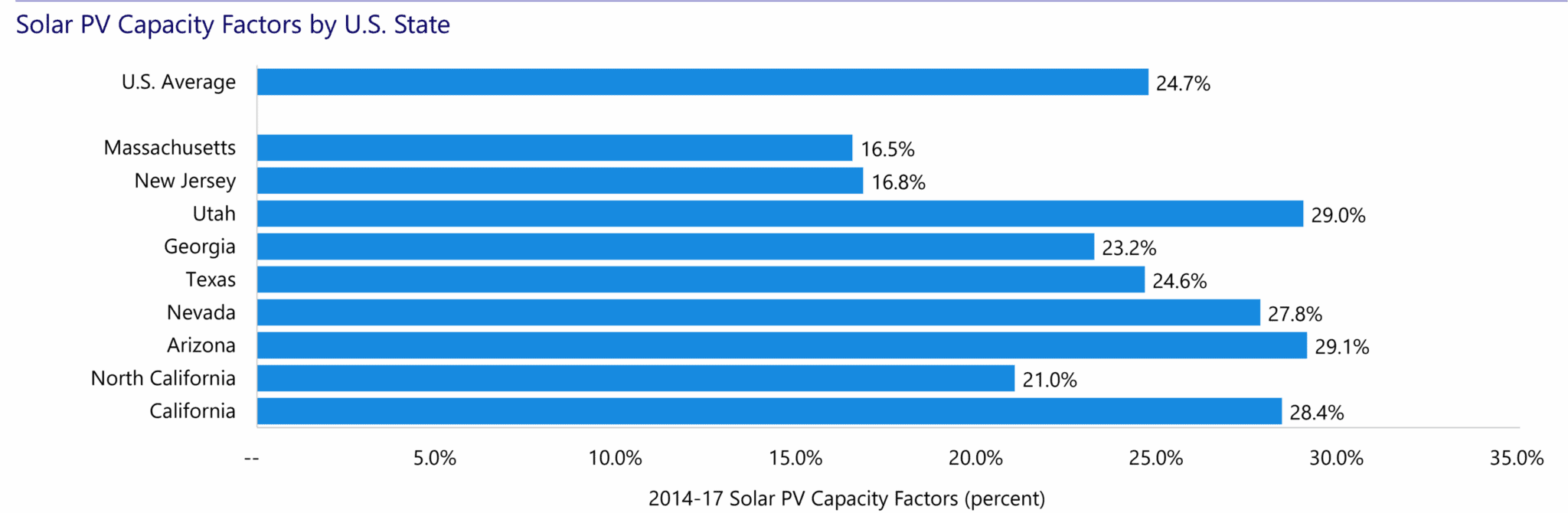
The chart below demonstrates how building solar farms in regions with more sunlight, such as the U.S. Southwest, leads to higher capacity factors (i.e. power outputs).
Future Outlook
Over time we expect the proliferation of data powered decision-making tools to only increase, particularly with the rise of highly specialized AI models.
What is now a competitive advantage will soon become standard practice, as developers, investors, and regulators demand enhanced economic and environmental outcomes. As a result, data is not only shaping today’s projects — it is defining the future of clean energy deployment.